My Articles…
Let’s talk….
Dear Dyslexic Diary,
Well.
Here we are.
A whole website. Which feels slightly dramatic, considering this all started with me, a notebook, and a brain that refuses to line up in neat bullet points.
Welcome to Dyslexic Diaries.
This is not a motivational shrine. It is not a perfectly filtered academic portfolio. It is not a highlight reel of certificates and conferences where everyone nods thoughtfully.
This is where I record what I notice.
About higher education.
About psychology.
About power dynamics in staffrooms and seminar rooms.
About the subtle behaviours no one writes into policy documents.
I completed my Master’s in Psychology in mental health and wellbeing as a dyslexic learner. Which means I learned content and translated it at the same time. I was analysing research while also negotiating with my own working memory. I was writing critically while double checking how to spell critically.
And somewhere along the way, something shifted.
I stopped trying to prove I was capable.
I started observing who needed me to feel incapable.
That is a different skill entirely.
One of the biggest lessons I wish someone had quietly whispered to me at the beginning is this. Not everyone in your environment is invested in your growth. Some people are curious because they admire you. Some are curious because they are measuring you. A few are curious because they are calculating.
It does not make you cynical to notice patterns. It makes you informed.
As dyslexic learners, especially in teaching and leadership roles, we often lead with openness. We share ideas. We collaborate generously. We assume people are playing the same game we are. Most are. Some are not.
Psychology gave me language for what I had sensed for years.
Education gave me case studies.
Life gave me data.
This space is where I bring those together.
You will find reflections on human behaviour. On confidence. On internal authority. On the quiet strength it takes to stay kind without becoming naive. On building competence without broadcasting every achievement to prove your worth.
If you are a dyslexic learner in higher education.
If you are a teacher navigating complex personalities.
If you are a woman over forty who is done shrinking in rooms that underestimate her.
You are in the right place.
This is not about becoming louder.
It is about becoming clearer.
Welcome to the observation files.
From A Dyslexic Psychologist in Training
Cindy Ettienne-Murphy BA(Hons) QTS NPQH MCCT MSc

Confidence is something I’ve been accused of lacking my entire career.
Not because I didn’t have it.
But because I didn’t wear it loudly enough.
I’ve lost count of the number of times someone has looked surprised when I spoke with certainty. Or when I questioned something thoughtfully. Or when I named a pattern they were skirting around.
“Oh. You’re actually really insightful.”
“You’re actually very academic.”
“I didn’t realise you’d thought about it like that.”
Actually.
As if thinking deeply was an optional extra.
As if reflective intelligence was a party trick I’d been hiding.
In education, confidence is often confused with performance. The fastest answer. The strongest opinion. The ability to dominate a meeting without checking whether the room is still breathing.
But teaching has never rewarded quiet certainty. It rewards visibility. Compliance. The ability to sound sure even when you are holding uncertainty carefully in both hands.
I have spent years watching some of the most emotionally intelligent, perceptive, skilled educators doubt themselves because they do not fit the aesthetic of confidence that schools have decided matters.
Too thoughtful.
Too cautious.
Too sensitive.
Too reflective.
All code for not performative enough.
Teaching is a profession built on constant evaluation. Observations. Targets. Data. Metrics. Somewhere along the way, many of us learned to outsource our confidence to external approval. If it is not written down, measured, or validated by someone higher up the ladder, we begin to question whether it counts at all.
And if you are neurodivergent, reflective, female, or all three, that erosion happens quietly and over time.
Confidence does not vanish in one dramatic moment. It thins. It wears down. It becomes something you apologise for having.
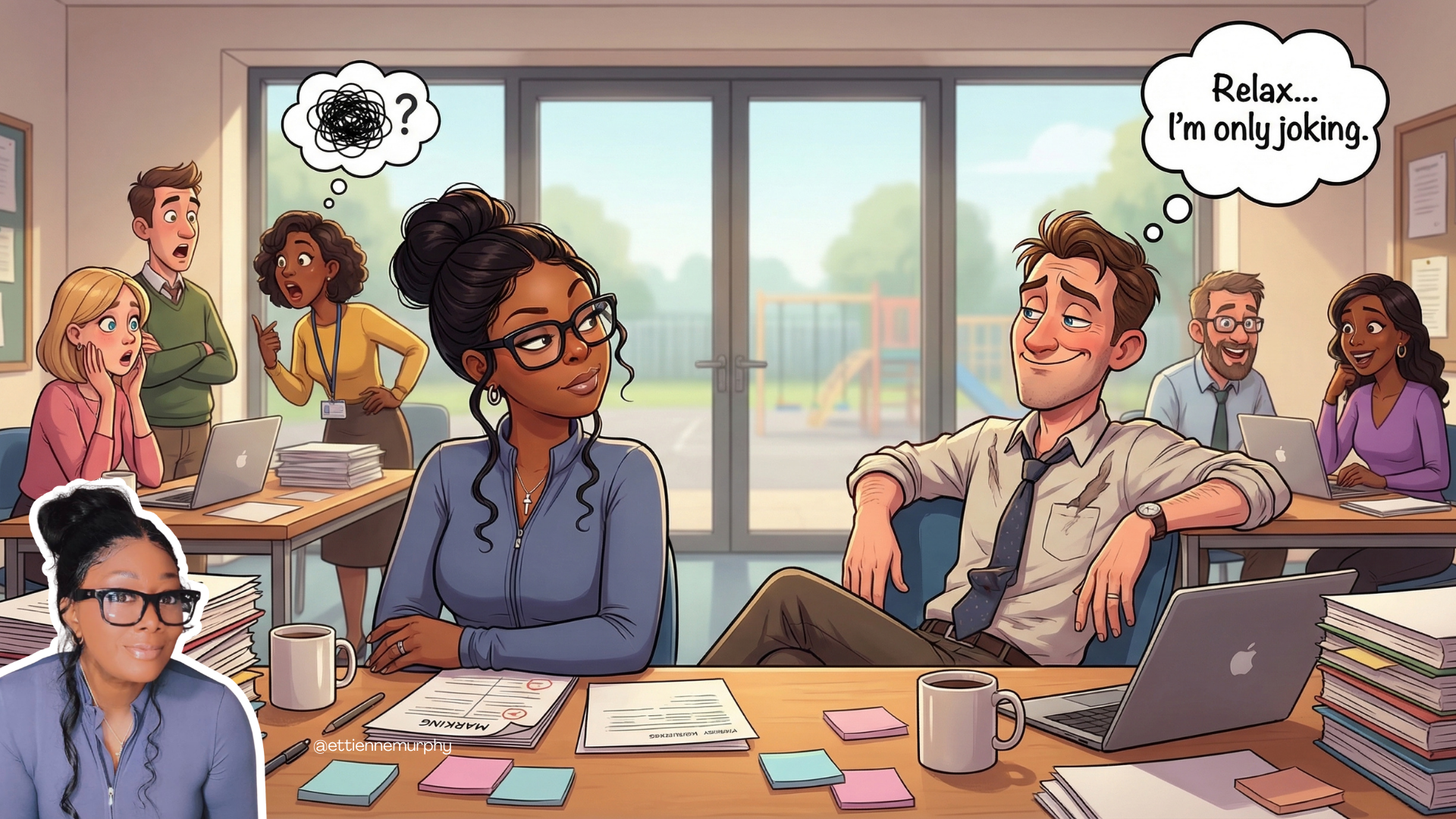
I remember sitting in meetings knowing exactly what the issue was, but waiting to see if someone else would say it first. Not because I was unsure. But because experience had taught me that being right is not always the same as being received.
Eventually, someone would land on the same conclusion. Louder. Later. With more authority attached. And suddenly the room would nod.
Funny how that works.
Teaching requires an extraordinary level of emotional labour. You regulate yourself so that children can feel safe. You absorb tension so that learning can happen. You hold complexity while presenting simplicity. You do this daily, quietly, and often without recognition.
That is not insecurity.
That is restraint.
Confidence does not always speak first. Sometimes it listens, waits, and chooses its moment.
There is a version of confidence that looks like certainty. And there is another that looks like trust. Trust in your judgement. Trust in your experience. Trust that you do not need to perform intelligence to possess it.
As educators, we need to widen the story we tell about what confidence looks like. Not everyone is meant to be loud. Not everyone needs to dominate. Some of the strongest professionals I know are the ones who remain steady when everything else is noisy.
Confidence can be quiet.
And in education, it often has to be.
You do not need to become louder to be legitimate.
You do not need to harden to be credible.
You do not need to prove your worth to people who only recognise one shape of authority.
You just need the nerve to trust what you already know.
And keep going anyway.